
Former Watson Fellow and social entrepreneur Srikar Gullapalli talks about the issues affecting India's growth and tells us why he wants more people to actively participate in building a bright future and put India on the global map.

It is actually quite remarkable that EPW has survived for so long. "I see it as a journal of dissent," says Rammanohar Reddy and is thankful to the EPW community for keeping it relevant.

Months before 8/11, MP, Haryana probed note ban
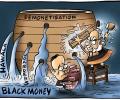
'Modi is likely to make more announcements to win or retain popularity, and put himself at the centre of things even more than now,' says T N Ninan.

Choose a career that motivates you and one that you are good at, says Prof RSS Mani, education consultant and vice president-institutional development, ITM Group of Institutions.
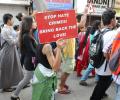
'The prime minister has merely paid lip service condemning these crimes instead of launching a massive crackdown against such brutalities,' argues Professor Mohammad Sajjad.

The government's negligence towards this 'treasure house of knowledge' can be seen from the fact that monkeys roam about freely in the reading rooms, disturbing the calm of the library, as well as putting the lives of the readers in danger, writes Sajad Ahmad Dar.

City governments must work out the treatment system for faecal sludge.
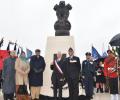
'The Indian Army served with honour and distinction in France and Flanders, East Africa, Gallipoli, Aden, Egypt, Mesopotamia, Palestine, Transcaspia, Persia and even China.' 'The sacrifice of India's soldiers was consigned to the dustbin of history in the post-colonial world.'

Who were they? What led them to mass murder?

N Sundaresha Subramanian digs deeper into what Catalyst, an Indo-US project, brings to the payments ecosystem.
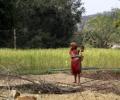
The government may claim planted trees compensate for forests lost, but that does not mean complex flora and fauna destroyed have been restored, points out Himadri Ghosh.

'In the first elections, Hindutva forces got only 6% of the votes and won only 10 seats.' 'It was a great defeat for them.' 'They have held that grouse against Nehru since then.'
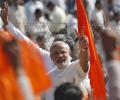
'A change of government will bring about a lot of changes because everything is frozen for the last two years. So, the frozen energies of India will be released.' Swadeshi Jagran Manch convenor Swaminathan Gurumurthy discusses the Modi phenomenon with Shobha Warrier/Rediff.com

In Muthuvel Karunanidhi's passing, Tamil Nadu has lost the last of its Titans.

The chief of America's Federal Communications Commission is not a fan of net neutrality. So what's his vision of communications and digital policy in these times?

What is Change really like in Bihar? Once seen as India's basket-case, what is its turnaround story like?
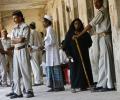
Muslims need to get out of their Isolation Syndrome, argues Mohammad Sajjad.

'Xi Jinping is keen that the second Trump-Kim summit happens soonest.' 'Kim is reported to have told Xi that he expects to achieve a result from a second summit that the international community would welcome,' points out Dr Rajaram Panda.

'This is not a Sanjay Baru or Natwar Singh type of book. It's not a memoir. It's not a book to reveal conversations, real or imaginary. This is not a book to position myself at the centre of the world.' Jairam Ramesh on his stint as environment minister.

Finance Minister P Chidambaram, while addressing the Carnegie Endowment for International Peace on "Recapturing India's Growth Momentum" in Washington on Thursday, said that the leading think tank need not launch an initiative to explore how India will vote in 2014, declaring that the Indian polity will vote the Congress back into power.

'If the dimensions of the strategic partnership worked out by India and the US seem like a grand alliance targeted at you-know-who, China had better realise that it has fathered it,' says B S Raghavan, a long time observer of China.

Friends and colleagues pay rich tributes to the "charming, approachable, and very accessible" Indian Constitution scholar Granville 'Red' Austin.
Indian states are preparing for a Rs 1.9 lakh crore (Rs 1.9 trillion) tax windfall this fiscal year.

Kashmir was indeed in need of a messiah that summer; 70 per cent of its population aged below 31 were up in arms against the Indian State. Every nook and corner of the land brought forth stories of youngsters with crushed bodies and an unfaltering spirit.

'The darkest days of Indian democracy were (during) the Emergency when basic democratic rights were suspended. For a time it seemed as though India would move along the East Asian model -- everybody works hard, nobody asks questions, certainly not of the government.' 'There are people who say we are headed that way, but I am not persuaded by the evidence,' says Mahesh Rangarajan who recently resigned as director of the Nehru Memorial Museum and Library in New Delhi.

'How many people have been skilled up and thus able to escape from needing to be in NREGA? The true success of NREGA would lie in its irrelevance -- that is, people no longer need it as a crutch.' 'NREGA should enable them to climb out of poverty and stand on their feet.' 'But this is expressly forbidden by NREGA rules. Skill development, which is what India needs more than anything else, appears to be outside the purview of NREGA,' points out Rajeev Srinivasan.

The decision marks first successful policy intervention.
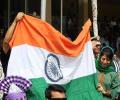
In her maiden Independence Day address as Chief Minister, Mehbooba made an emotional appeal to the youth indulging in violence, telling them not to be misled by the "vested interests" who want to keep Kashmir burning, and prevent the beautiful valley from turning into another Syria or Afghanistan.

'There are so many dimensions to history that we need to attend to: We need more space for local and regional histories; we need to delve into the histories of particular communities; we need to emphasise gender history and environmental history.' 'We need to think about India's history beyond India's current borders.'
It is regrettable that the IB has tried to devalue the expertise available both within the concerned ministry and in the scientific community by its allegations. Governments and NGOs in many western nations have not been accused of being 'anti-national' when they put their foot down on questionable practices by cash rich agri-business companies, says Rashme Sehgal.

'Tell me, what is more important to Modi -- his position as prime minister or as an RSS pracharak?' 'We feel he gives priority to his position as an RSS pracharak. Otherwise, why did he not agree to go to Parliament as the prime minister of the country and air his opinion on ghar wapsi as demanded by the Opposition?'

Is it just the glamour?

Admittedly, EVMs too have a UID number and any convergence of data can make the secret ballot system a party of history, warns Dr Gopal Krishna in the 5th part of his series against Aadhaar.

If the chemistry between Modi and Xi Jinping goes well, it will herald a new future not just for the region but for the world, says Tarun Vijay.
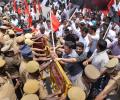
Protester Sasi Perumal's death has given a new fillip to the pro-prohibition movement, which was beginning to draw attention across Tamil Nadu after different political parties began to make it a part of their poll manifesto for next year, says N Sathiya Moorthy.

A Muslim man taking a PhD in a dance form is not unusual, but it becomes interesting when the dance happens to be Mohiniyattam, says Shobha Warrier

'Why should the people of Odisha divert water from the Mahanadhi when 13 out of 32 districts are chronically drought prone?' 'Water is a state subject. Can you really nationalise rivers for which you need drastic amendments in the Constitution?'

To avert another Uttarakhand-type catastrophe, we must change course. We should stop pandering to the Indian elite's insatiable appetite for electricity, which is driving reckless dam construction, says Praful Bidwai

Maharashtra Finance Minister Sudhir Mungantiwar speaks to Prasanna Zore/Rediff.com.
 © 2026 Rediff.com - Advertise with us - Disclaimer - Privacy Policy - Sitemap - Feedback - About us - Terms of use - Grievances